
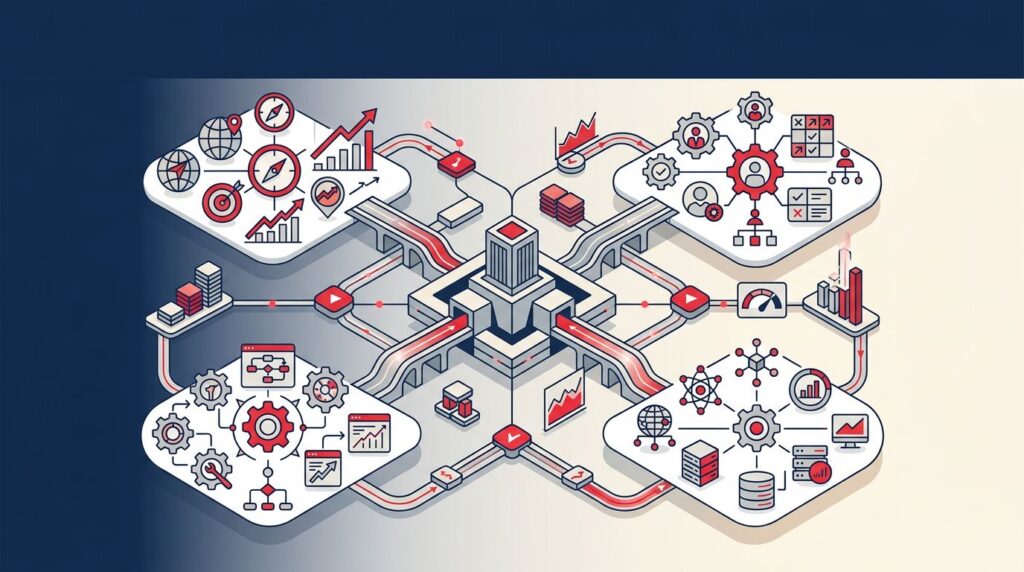
Growth gets harder when strategy, people, processes, technology, and decision rights stop working as one system. You may have capable teams and good intentions, yet still face slow decisions, rising cost, weak reporting, and too much dependence on workarounds.
There is no single universal list of operating model elements. This practical 12-part framework gives you a way to see where execution is breaking and what needs attention first. A business-aligned technology strategy helps connect those operating choices to the company goals that matter.
Key takeaways
- An operating model explains how you turn strategy into repeatable results.
- Clear ownership matters as much as capable people and good tools.
- The strongest models connect decisions, investment, risk, and performance.
- You do not need a major transformation program to fix the biggest gaps.
The 12 Elements of an Operating Model, Grouped Into Four Areas
An operating model describes how you organize work, make decisions, use resources, and deliver results. The 12 elements are:
- Strategy and goals
- Structure and accountability
- Governance and decision rights
- Organizational design
- Roles and capabilities
- Culture and ways of working
- Core processes and workflows
- Performance management
- Continuous improvement
- Technology and data
- Financial resources and investment
- Partners and vendors
These elements fall into four connected areas: direction and governance, organization and people, processes and performance, and technology and external support. If you improve one area while ignoring the others, the same problems usually return in a new form.
Organizations that need help connecting these moving parts can explore operating model and technology leadership services.
Direction and governance set the rules for how you operate
The first three elements give the business direction.
Strategy and goals define the outcomes you want. They should answer plain questions. Where are you trying to grow? What needs to improve? Which risks can you not afford to ignore?
Structure and accountability show who owns each major outcome. A roadmap without a clear owner is only a list of hopes. Your technology strategy should connect to a current technology roadmap with named owners, timing, and tradeoffs.
Governance and decision rights set the rules for approving spend, accepting risk, choosing vendors, and escalating problems. If those rules are unclear, decisions bounce between departments until progress stalls. That is often a sign of a broader technology leadership gap.
People and organization turn plans into daily action
Elements four through six deal with how people work together.
Organizational design shows how teams fit together. It tells you whether customer delivery, finance, operations, technology, and risk work through clear handoffs or rely on personal relationships.
Roles and capabilities are different. A clean structure does not help if nobody has the skills, authority, or capacity to deliver. You may have strong technical managers who keep systems running, but still lack executive technology leadership for enterprise-level tradeoffs.
Culture and ways of working shape what happens when plans meet pressure. Do people raise problems early? Do teams own outcomes or defend their lane? Can managers challenge a bad decision without creating friction?
When executive ownership is missing, fractional CTO leadership can provide steadier direction. The question of when to hire a fractional CTO usually comes down to whether technology has become too important to manage informally.
Processes and performance create a repeatable operating rhythm
The next three operating model elements turn plans into consistent action.
Core processes and workflows define how work moves from request to result. That includes customer onboarding, order fulfillment, software delivery, incident response, budgeting, and approvals. Weak handoffs create rework, delay, and customer frustration.
Performance management tells you whether the work is producing the right result. You need a small set of shared measures across business performance, delivery, customer experience, cost, and risk. A dashboard full of tickets and project updates rarely helps leaders decide what to fund or stop.
Continuous improvement gives you a way to fix recurring problems. Regular reviews should expose bottlenecks, weak ownership, manual work, and vendor issues before they become normal.
A clear approach to aligning technology with business goals keeps measures tied to business outcomes. A one-page technology strategy can make priorities easier to see, while technology spending ROI keeps investment discussions honest.
Technology and external relationships support the work
The final three elements are where many leadership teams feel the most drag.
Technology and data should make work easier to scale. Systems must integrate well enough for people to trust the data. Security, access controls, technical debt, and data quality all affect whether your operating model holds under pressure.
Financial resources and investment connect spending to a result. Your budget should show what each major investment is meant to change, who owns that outcome, and what happens if you delay it.
Partners and vendors extend your operating model. They should support your direction, not write it for you. That requires clear contracts, service levels, accountability, and total-cost visibility.
Technology oversight support can help when systems, vendors, and reporting need stronger executive control. Tool sprawl is a governance problem when overlapping products create cost and confusion. You also need to know how to stop vendors from driving your roadmap, especially before a major purchase, acquisition, or platform change.
How Each Operating Model Element Works in Practice
A useful operating model does not treat these 12 elements as separate boxes. It connects them.
Say you want to improve customer delivery and protect margin. That goal affects who owns delivery performance, how teams hand work off, which systems hold customer data, what you measure, which vendors matter, and where you invest.
If your customer operations team still rekeys data between systems, the issue is not only software. You may have a workflow problem, a data ownership problem, and an investment decision that was never tied to customer outcomes.
Start with business outcomes, then design around them
Begin with three to five outcomes that matter this year. You might choose faster delivery, lower cost to serve, stronger customer trust, reduced cyber risk, or cleaner management reporting.
For each outcome, name the accountable owner. Then identify the capabilities, process changes, technology support, budget, and measures required. Funding projects without naming the result creates activity without value.
Your operating model should make those connections visible before teams compete for money and attention.
Make ownership and decision rights visible
Responsibility means someone does the work. Accountability means someone owns the result.
For every material initiative, name a business sponsor, an operating owner, and a technology lead. Then define who decides on scope, budget, risk acceptance, architecture, vendor selection, and timing.
Unclear ownership creates duplicated effort and soft reporting. During a leadership transition, interim CTO leadership can provide immediate executive ownership while you decide on the longer-term structure.
Use reporting to help leaders act
Useful reporting shows progress against outcomes, spending, risks, dependencies, decisions needed, owners, and the consequence of delay. It should not bury the executive team in technical detail.
Your board owns oversight, not daily execution. It needs a clear view of tradeoffs, risk, and ownership.
Use board technology reports to frame decisions, not activity. Strong technology risk oversight should include a board-ready cybersecurity reporting template and clear guidance on what to report to the board about cyber.
How to Assess Your Operating Model Before You Change It
You do not need a thick transformation document to assess your operating model. Review each of the 12 elements and rate its clarity, effectiveness, ownership, and risk.
Talk to leadership, operators, finance, legal, technology teams, and key vendors. Ask where work slows down, where decisions get stuck, and where people rely on spreadsheets or personal favors to keep moving.
The goal is not perfection. Find the few constraints creating the most business drag.
Look for warning signs that the model is out of balance
Watch for familiar symptoms:
- Priorities change without a clear decision.
- Projects have no accountable business sponsor.
- Teams depend on manual workarounds.
- Reports track tasks but not outcomes.
- Vendors shape the roadmap.
- Tools overlap and data conflicts.
- Risk has no named owner.
- Technology spending rises without a clear return.
These are often leadership, governance, process, or data problems. They are rarely solved by buying one more platform. Questions about cyber risk appetite and third-party risk reporting can expose gaps that normal status reporting misses.
Turn the assessment into a focused 90-day plan
Choose two or three high-value gaps. Assign owners, define measures, and set a review rhythm.
Your first 90 days might clarify decision rights, remove duplicate tools, fix a critical workflow, build a board-ready risk view, or create a realistic roadmap. A short plan with follow-through beats a long document nobody uses.
If the picture still feels scattered, Get an Executive Technology Clarity Check to identify what is slowing growth and what needs executive ownership first.
Common Operating Model Mistakes That Slow Growth
Treating the operating model as an organization chart
An organization chart shows reporting lines. It does not show how work flows, who makes decisions, what systems support delivery, or how performance is measured.
Map your value streams, important decisions, dependencies, and handoffs alongside the chart. Otherwise, you can reorganize people and leave the same friction in place.
Adding tools before fixing ownership and process
New software cannot repair unclear accountability or a broken workflow. Before approving a tool, define the business problem, the owner, the process change, the expected outcome, and the total cost.
Technology debt includes more than old code. It also includes weak governance, messy data, vendor dependence, and systems nobody can explain during technology due diligence.
Reporting too much while explaining too little
Long reports can leave leaders unsure what is stable, what is risky, and what needs a decision. A better report names the issue, business impact, owner, timing, recommendation, and consequence of delay.
That is the difference between activity reporting and reporting leaders can trust.
Frequently Asked Questions About Operating Model Elements
Are these the only elements in an operating model?
No. Different frameworks combine or split categories in different ways. The real test is whether your model explains how strategy becomes coordinated work, investment, decisions, performance, and results.
Who should own an operating model?
The CEO owns the business outcome. The COO, another executive, or a transformation leader may own the operating rhythm. Technology leadership should own architecture, delivery tradeoffs, technology risk, and related decisions.
Shared input does not mean shared accountability.
How often should you review your operating model?
Review it formally at least once a year. Revisit it sooner during rapid growth, an acquisition, leadership transition, cyber event, or major strategy change.
Monthly and quarterly reviews should show whether the model is still helping the business move. If you need experienced leadership without rushing into a full-time hire, talk to a fractional technology executive.
Build a Model That Makes Execution Easier
The 12 elements of an operating model work as one connected system. Your aim is not more bureaucracy. You want clearer direction, stronger ownership, better processes, trustworthy reporting, disciplined investment, and external support that does not control your business.
Assess the model you have now. Identify the biggest gap. Then build a focused 90-day plan that gives your leadership team a clearer path forward.
If growth, diligence, or transition is exposing weak technology ownership, Prepare Technology for Diligence or Transition with an executive technology leadership partner that helps you make calmer, more confident decisions.