
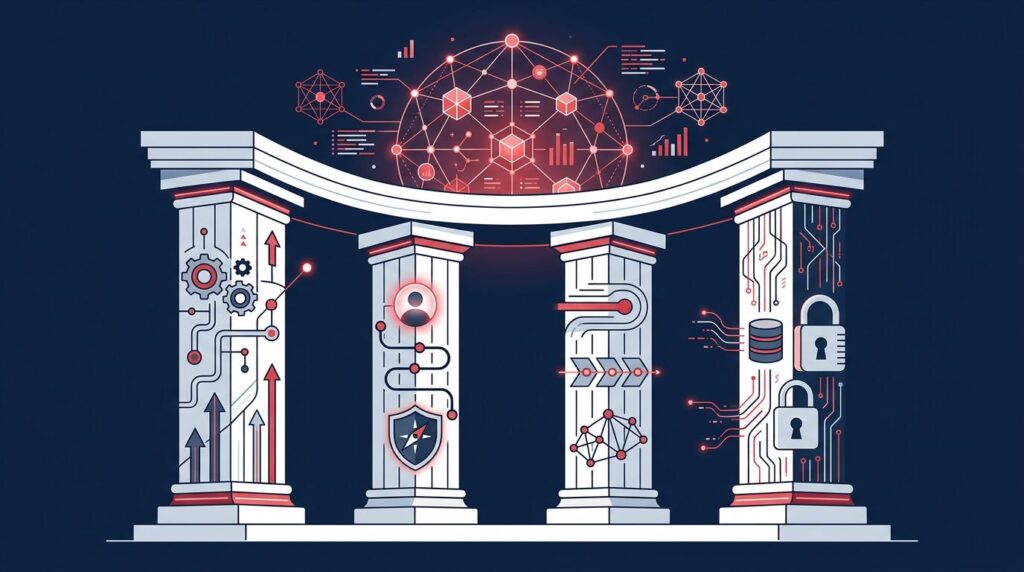
What are the pillars of digital strategy? To successfully guide your digital transformation, you must focus on four essential components: business alignment, customer experience, operational excellence, and technology, data, and security.
These four pillars form the backbone of a successful digital transformation, helping organizations modernize their business models for long-term growth. Business alignment ensures that every digital initiative directly supports your corporate goals. Customer experience turns your digital investments into tangible value for the people you serve. Operational excellence makes your processes repeatable and scalable, while a robust framework for technology, data, and security provides the foundation needed to protect trust and produce measurable results.
If you are a CEO, COO, founder, or board member, you do not need another list of software trends. You need a technology strategy that makes the business easier to run.
What Are the Four Pillars of Digital Strategy: A Systemic View
The pillars of a digital strategy are deeply connected, functioning as a cohesive system to drive successful digital transformation. Business goals set the overall direction, while customer experience creates genuine business value. Operations ensure that value is delivered consistently, and technology, data, and security act as the foundation that holds the entire structure together.
A weak pillar limits your digital readiness and hinders the performance of the other areas. You might invest in a sophisticated customer portal, for example, but it will not provide the expected returns if the underlying data is inaccurate or if internal approval processes remain sluggish and inefficient.
A practical strategy focuses on measuring outcomes that leadership can clearly understand:
- Revenue growth and retention
- Margin improvement and lower cost to serve
- Faster delivery and fewer manual workarounds
- Better customer trust and stronger resilience
- Lower technology and cyber risk
The goal is not to drive more digital activity for its own sake. It is business-aligned technology strategy that provides better control and clearer decision making. True success starts by aligning technology with business goals, ensuring that every digital initiative is grounded in clear business alignment rather than simply purchasing the latest platform.
Business Alignment Gives Your Digital Strategy a Clear Direction
Your digital strategy should begin with the business plan, not a vendor presentation. Before defining your priorities, conducting a digital maturity assessment can help you evaluate your starting point and identify where the most significant gaps exist.
Start with the questions leadership already cares about. Where should growth come from? Where is margin leaking? Which customer problems are hurting retention? What risk can you no longer accept?
Then turn those priorities into a small number of digital outcomes. If your goal is faster growth, your digital priority may be improving lead response time or quote-to-cash speed. If your goal is margin improvement, it may be reducing duplicate work, system overlap, or manual reporting.
A short one-page technology strategy acts as a strategic roadmap that makes those choices visible. It gives leaders a practical view of what matters, what it costs, who owns it, and what happens if it slips.
Turn Business Goals Into Measurable Digital Outcomes
Every major initiative needs a clear business case. “Upgrade the CRM” is not a business outcome; it is just a task. Instead, focus on the business value by framing the goal as “Improve forecast accuracy so sales leaders can staff the pipeline earlier.” This shift toward data-driven decision making ensures that technology investments are directly tied to tangible performance improvements.
Useful outcomes might include reducing quote-to-cash time, lowering customer churn, cutting manual data entry, or improving service response times.
For each significant initiative, name:
- A business owner who owns the result
- A technology owner who owns delivery
- A target outcome and measure
- A budget and review date
- The tradeoffs leadership has approved
Technical milestones still matter, but they are not the same as business results. A project can be delivered on time and still fail to improve revenue, margin, or customer experience.
Use Governance to Keep Priorities From Drifting
Without clear decision rights, every department can create its own urgent technology request. The roadmap becomes a list of competing opinions. Effective leadership and governance provide a framework to manage these requests and ensure resources are allocated to the highest impact projects.
A regular leadership review gives you a place to approve tradeoffs, stop low-value work, and ask what is slipping. Strong executive technology leadership keeps those conversations tied to business consequences.
Your board should oversee major spend, risk, resilience, and alignment. It should not manage the daily roadmap. Useful board technology reports show what matters now, who owns it, and what decisions need attention. That is the core of sensible technology risk oversight.
Customer Experience Turns Digital Investment Into Customer Value
Improving your digital customer experience is not about a simple website redesign project. It is about how customers interact with your business when they need information, request a quote, place an order, ask for help, or manage an account. Cultivating true customer-centricity is the essential mindset required to ensure these interactions provide genuine value.
You can have attractive pages and still frustrate users. A slow response, conflicting information, repeated forms, or an invoice that is difficult to understand will undo a lot of good design work.
Map the customer journey that matters most before choosing technology. Ask where customers wait, repeat themselves, abandon the process, or contact your team because the system did not provide a clear answer. By focusing on these specific touchpoints, you set a stronger foundation for your broader digital transformation goals.
Remove Friction From the Moments Customers Care About
Look at the handoffs behind the experience. A customer may see one brand, but your team may be working across a CRM, billing system, support platform, shared spreadsheet, and inbox.
Poor data, disconnected systems, slow approvals, and unclear ownership create friction even when each tool looks acceptable on its own.
Focus first on high-value moments. For many companies, that means finding information, requesting a quote, completing a purchase, getting support, or renewing a service. Make those moments easier before adding features nobody asked for.
Measure Experience With Business and Trust Signals
Customer satisfaction is useful, but it is not enough by itself. Pair experience measures with business results.
Track completion rates, response times, customer complaints, retention, conversion, repeat purchases, and cost to serve. If a new portal reduces support calls but increases abandoned applications, you need to see both sides to truly understand your digital customer experience.
Digital trust also matters. Customers expect privacy, accessible services, accurate communication, and systems that work when promised. Trust is hard to recover once it is lost.
Operational Excellence Makes Digital Work Repeatable and Scalable
Operations are where strategy either becomes real or gets buried under workarounds.
New tools will not fix unclear workflows, duplicate data, weak handoffs, or vague accountability. Those issues often point to a wider technology leadership gap, not a shortage of software. Achieving true operational efficiency requires processes that people can follow without heroic effort, which is often hindered by a resistant organizational culture. You need clear ownership, agreed handoffs, reliable reporting, and a practical view of technology spending ROI.
Simplify Processes Before You Automate Them
Before you implement process automation for an order flow, approval sequence, or incident response plan, document what happens now.
Remove steps that do not add value. Define who hands work to whom. Agree on what a good result looks like. Then, use effective change management to transition to a state where you automate only the parts that reduce errors, delay, or repeated effort.
Automation can make a good process faster. It can also hide a broken process behind nicer screens.
If your team cannot explain the process in plain language, it is not ready for automation.
Control Vendors, Tools, and Technology Debt
Tool sprawl is not only a cost problem. It is a governance problem that can derail your entire digital transformation effort.
Overlapping subscriptions create duplicate records, weak access control, inconsistent reporting, and vendor dependence. A vendor should not be making strategic choices because nobody inside the company owns the decision.
Every important vendor needs a business owner, performance expectations, security requirements, a renewal review, and an exit plan. Treat tool sprawl as a governance problem, not an accounting cleanup exercise.
You also need to stop vendors from driving your roadmap. Your business priorities should decide what comes next.
Technology, Data, and Security Provide the Foundation
The fourth pillar serves as the digital infrastructure that supports the other three. It encompasses reliable systems, usable data, appropriate architecture, cybersecurity, privacy, integration, backups, and recovery.
This is not about chasing the newest technology or jumping into trends like artificial intelligence before you are ready. It is about having systems that are fit for purpose, safe to operate, maintainable, and able to support your business plan. Whether you are leveraging cloud computing or managing legacy servers, the goal is to ensure your environment remains stable and secure.
Growing companies often need stronger executive judgment before they need another full-time hire. Fractional CTO services can provide ongoing direction when technology has become too important to manage informally.
Build Data Leaders Can Trust
Leadership needs data and analytics that mean the same thing across sales, finance, operations, and technology.
Weak information creates weak forecasts. It also slows decisions, frustrates customers, and keeps teams arguing about whose spreadsheet is correct. To move forward, you must prioritize strong data governance by naming specific data owners and agreeing on core definitions before building another dashboard.
Start with the decisions that matter most. If you need better visibility into pipeline, margins, customer retention, or service performance, improve the data and analytics behind those specific decisions first.
Manage Cyber Risk and Resilience as Business Issues
Cybersecurity includes prevention, detection, response, recovery, access control, vendor risk, tested backups, and accountability. It is not a technical task you can hand off and forget.
Your board should understand the business impact of major risks, the owners, the acceptable thresholds, and the actions underway. A clear cyber risk appetite helps leadership decide what level of exposure it can live with.
Use a board-ready cybersecurity reporting template to show risk in plain language. Boards also need clarity on what to report about cyber and how third-party exposure affects the company through vendor risk reporting.
How to Build a Digital Strategy Around the Four Pillars
Do not try to fix everything at once. Start by assessing your digital capabilities to see where the business is feeling the most drag.
Confirm the business priorities. Identify gaps across the four pillars. Choose a small number of measurable outcomes. Assign owners. Build a focused 90-day roadmap designed to create a sustainable competitive advantage. Then review progress on a steady cadence.
Address the weakest high-impact area first. If customer data is unreliable, fix that before launching a sophisticated analytics program. If your team lacks necessary digital skills, address those gaps before committing to new vendor contracts.
CTO Input services can help when growth, transition, or risk has made the operating picture harder to trust. If you are preparing for an acquisition, major investment, or complex digital transformation, technical due diligence can expose issues before they become expensive surprises.
Choose Measures That Show Business Progress
Use a balanced scorecard. Include growth, customer experience, operations, technology health, data and analytics, security, and risk.
You might track revenue influenced, cost to serve, cycle time, system availability, incident recovery time, project delivery, data quality, and critical risks with named owners.
The point is not perfect measurement. You need reporting leaders can trust over time.
Decide When You Need More Technology Leadership
A leadership gap often shows up when projects keep slipping, spend rises without visible value, vendors control major decisions, or nobody can explain risk clearly.
A fractional CTO fits when you need ongoing strategic leadership without full-time executive overhead. Read more about when to hire a fractional CTO if the business has outgrown informal technology leadership.
An interim CTO is different. That role fits when the seat is open, trust has been damaged, or urgent control is needed. If the answer is still unclear, you can talk to a fractional technology executive about the gap before making a rushed hire.
Common Mistakes That Weaken the Four Pillars
The most common mistake is starting with tools instead of outcomes. Prioritizing technology adoption over clear business goals often leads to increased activity without any real sense of direction.
Other failures follow the same pattern. Treating customer experience as a design project only ignores broken handoffs. Automating a poor process simply makes the poor process faster. Ignoring data ownership creates reports that nobody trusts.
Cybersecurity becomes dangerous when it is treated as a minor IT issue rather than a significant business risk. This requires a shift toward a more comprehensive digital mindset among leadership. Furthermore, when vendors gain too much control because leadership has not set clear priorities, status reports become nothing more than noise, showing plenty of activity but very little actual business impact.
Each mistake adds drag, confusion, wasted spend, or risk. While none of these issues require a dramatic fix, they do demand clearer ownership and better decisions. Often, the path forward involves investing in upskilling and reskilling your workforce to help them adapt to new governance models. Failing to address these errors can quickly stall your broader digital transformation and sap your organizational momentum.
Frequently Asked Questions About the Pillars of Digital Strategy
What are the four pillars of digital strategy?
The core components that make up the pillars of digital strategy are business alignment, customer experience, operational excellence, and technology, data, and security.
Are the four pillars the same for every company?
These categories serve as a useful framework across all industries. However, your specific priorities will shift based on your unique goals, risk appetite, customer base, and operating model, as well as your capacity for agile innovation.
Which pillar should you address first?
Start with the weakest area that has the greatest business impact. That may be poor customer data, vendor dependence, slow operations, or a lack of clear strategy ownership.
How do digital strategy and technology strategy differ?
Digital strategy describes how your organization uses digital capabilities to create sustainable customer and business value, often serving as the roadmap for your broader digital transformation. Technology strategy covers the systems, data, people, governance, and investment decisions that make those digital goals possible.
How often should you review your digital strategy?
Review your major priorities on a quarterly basis. Use monthly operating reviews to track delivery, manage risk, and make tactical decisions that cannot wait.
Can a mid-market company build this strategy without a full-time CTO?
Yes. Many companies utilize fractional, interim, or executive oversight support while they focus on building stronger internal digital skills and determining exactly what long-term leadership they need to scale.
Build a Strategy You Can Actually Run
The four pillars work best when they are treated as one unified operating system for your digital transformation. Business alignment gives you direction, while an exceptional digital customer experience gives the work meaning. Operations make delivery repeatable, and a robust digital infrastructure provides the foundation you can trust.
If your priorities are scattered or ownership remains unclear, schedule a digital maturity assessment through our Executive Technology Clarity Check. This process helps you identify exactly what is slowing your growth, where technical risk is building, and which areas need your attention first.
If you are facing an acquisition, leadership change, or major transition, use these insights to prepare your technology for diligence. Building stronger digital capabilities now ensures you can make more confident, data-backed decisions when the pressure rises.